By Brandon Hubbard-Heitz
Nearly three years ago Chattanooga 2.0 embarked upon an ambitious plan to double the number of elementary students reading and writing on grade level in Hamilton County by 2030. During the pandemic, local proficiency rates dipped to 36%. Even so, the time was ripe for our kids. In 2021, the Tennessee General Assembly passed significant legislation to prioritize literacy instruction grounded in the Science of Reading as well as new supports for students struggling to master foundational literacy by the end of third grade. At the same time, Hamilton County Schools adopted a new elementary English language arts curriculum that prioritized evidence-backed strategies for teaching kids to read while also building a knowledge base to set them up for success beyond fifth grade.
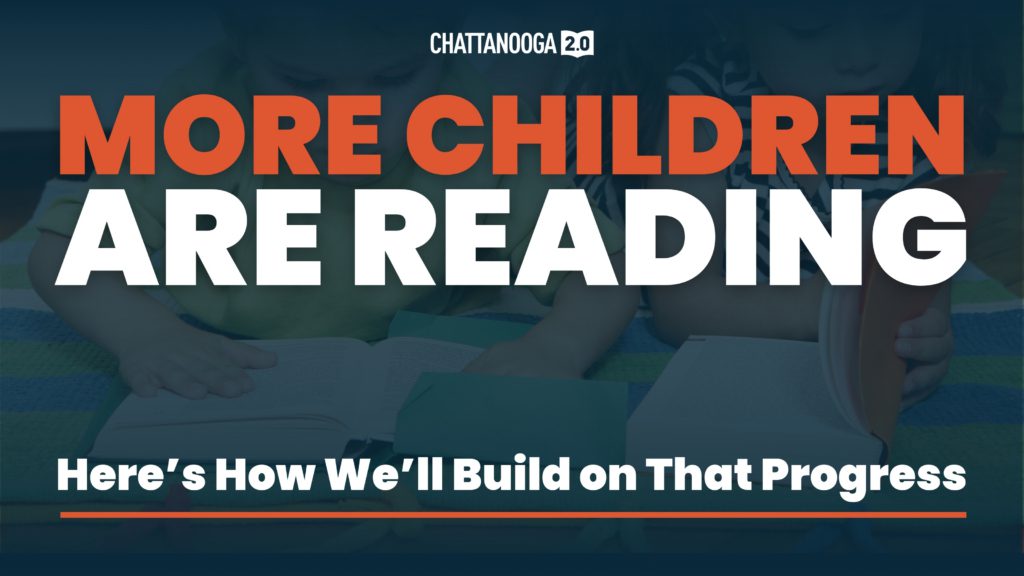
But literacy is not just the responsibility of our schools. A child’s journey to literacy begins before birth and encompasses experiences at home, in school, and across the community. A literacy proficient community requires entities to come alongside and compliment the impactful work being done in the schools. That’s why we have worked hard over the past three years to build a robust and aligned system of literacy supports. While not everything has worked, and for some of our early strategies, it’s too soon to see the impact on state testing, it’s clear that coordinated strategy and collaboration between the school system, families, and the community, is leading to student growth. Last year, nearly 41% of students in grades 3–5 were reading on grade level. That’s about 500 more students than if reading rates had not improved since 2021!
But there’s a long way to go before we reach our community’s goal of 70% in just over 4 years. As we look ahead to the work still to be done, a few lessons have emerged that are shaping how we move forward.
- High-impact tutoring is a difference-maker for students in primary grades—and can be sustained through innovation and cross-sector partnerships.
What began as a pilot of the Literacy First tutoring model at East Side Elementary has now expanded to thirteen campuses across Hamilton County Schools. In the 2024–2025 school year, students receiving Literacy First tutoring from Hamilton County Schools’ classified staff saw meaningful gains. Kindergarten students strengthened their early reading skills, gaining the equivalent of 1.7 additional months of learning, while first-grade students gained 3.5 additional months compared to similar peers who did not receive tutoring. To reach even more students in the 2025–2026 school year, Chattanooga 2.0 secured AmeriCorps funding through Volunteer Tennessee to launch an additional tutoring pipeline while also partnering with the University of Tennessee at Chattanooga to enlist undergraduate teacher candidates as tutors. Today, nearly 750 students have received consistent, evidence-based support this school year, and we are seeing similar results across this expanded model as it becomes more sustainable over time through public systems and local partnerships.
- Families and community-based organizations want to build on what children are already learning in school.
Schools have already figured out that kids learn better with there is “instructional coherence” through the school day. We think that the same thing holds true for when kids are at home or elsewhere in the community. In practice, that means using Hamilton County Schools’ curriculum to “right-size” supports for families and community partners, so they can reinforce the same skills and topics wherever kids are. For example, through Family Reads, students receive books aligned to their classroom learning along with simple guidance for families to support literacy at home. Many parents report that these books help them better understand what their child is learning and have more conversations about it at home. Teachers have also observed students making connections between these books and their lessons. Similarly, out-of-school time providers using our K–2 literacy toolkit report improvements in their students’ foundational literacy skills through aligned read alouds, phonics routines, and hands-on activities.
- We can measure what happens in schools, but it is much harder to define the impact of literacy strategies implemented at home or across the community.
Over the past three years, Signal Centers has significantly increased enrollment in Dolly Parton’s Imagination Library, expanding access to books for young children across our community. This work, along with the efforts of local libraries and the Governor’s Early Literacy Foundation, is grounded in strong research about the importance of early exposure to books and language. At the same time, we know these investments will not show up in state testing scores for several years, and it is difficult to isolate their individual impact even over time. The same is true for out-of-school time programs and other efforts to create a literacy-rich environment beyond the school day. Most of the data we rely on to track literacy comes from school-based assessments, which can unintentionally reinforce the idea that schools alone are responsible for outcomes. If we want to improve literacy at scale, we must also value what is happening outside the classroom by pairing quantitative data with qualitative evidence such as family engagement, student experiences, and changes in daily reading habits.
- Improving literacy at scale will require a comprehensive approach that encompasses the full early childhood system of supports.
Literacy does not exist in a vacuum. While Hamilton County Schools has made important gains in third- through fifth-grade proficiency, significant gaps by income, race, and language remain. These gaps are closely tied to broader conditions affecting families. The Tennessee Commission on Children and Youth highlights how factors like the cost of child care, food insecurity, access to health care, and poverty shape children’s development long before they enter a classroom. At the same time, data from the United Way of Greater Chattanooga shows that more families are experiencing financial hardship, creating additional barriers for young children as they develop early language and literacy skills. This has pushed us to sharpen our approach to early childhood by focusing on clearer entry points for families and stronger coordination across supports—both in neighborhoods and at the policy level.
- No one has solved how to improve literacy at scale, which means failure and learning are an inevitable and necessary part of the work.
Over the past three years, we have achieved some big wins for our kids. But not everything has worked. We sunset multiple strategies that did not prove to be scalable or sustainable in our community, and we will likely have to do so again. Across the country, communities in networks like StriveTogether and the Campaign for Grade-Level Reading are working toward the same goal and grappling with many of the same challenges as Hamilton County. Improving literacy at scale is complex work, and progress depends on a willingness to learn, adapt, and continuously improve based on what we see.
The next chapter of this work will require deeper collaboration and continued innovation to sustain what is working and to build new partnerships and infrastructure needed to support children wherever they learn. That means families, schools, afterschool programs, faith communities, businesses, and public leaders working together in new and more connected ways. Much has changed since we began, but what remains constant is the essential role of literacy in helping our children achieve long-term success and economic independence. They are counting on us to get this right.