By Jennifer Andrews
Three years ago, we set out to do something both ambitious and necessary. As part of the statewide Bright Start TN Network, Early Matters and our partners launched the Early Childhood Action Plan with a simple but powerful goal: to better support our community’s youngest children by strengthening the systems around them. We knew from the start that no single program or organization could do this alone. What we didn’t yet know was how much we would learn by trying to do it together.
Over the last three years, partners across early learning, health, and family support aligned their work in new ways. Collectively, we invested in early literacy, strengthened kindergarten prep resources, expanded early intervention access, supported the child care workforce, and improved coordination across systems that families rely on every day.
Coming out of the worst of the pandemic, this county’s early childhood partners could have returned to silos – but they didn’t. We saw more children connected to early intervention, healthier birth outcomes, stronger foundational literacy skills in the early grades, and signs of improved stability for some families and providers.
At the same time, the work surfaced hard truths. Rising costs, population growth, and child care shortages continued to stretch families and providers in ways that local collaboration alone cannot fully solve. Providers shared how workforce instability and funding uncertainty affect quality and sustainability. Families told us how difficult it can still be to navigate fragmented systems. Because of this, we are actively exploring tools and shared platforms that could make it easier for parents to find, access, and stay connected to early childhood supports in real time. Again and again, we heard the same message: progress is real, but it feels fragile.
One of the clearest lessons from this work is that collaboration works. When partners align around shared goals, move data together, and build trust over time, change happens faster and more thoughtfully. But collaboration is not a substitute for sustained investment. Many of the barriers families and providers face are shaped by state and federal funding decisions, and local systems remain deeply dependent on those broader structures.
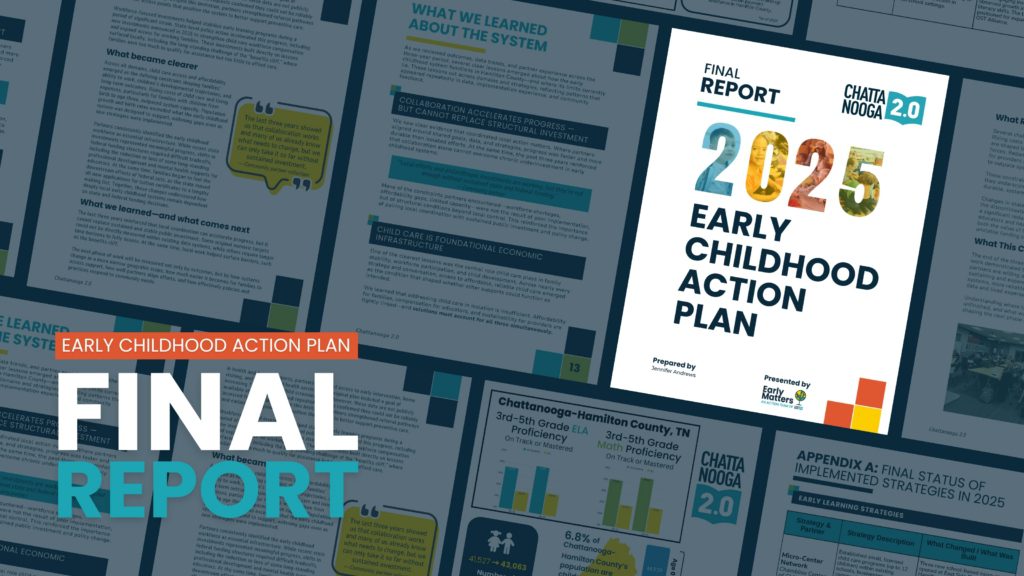
The final report reflects this dual reality. It lifts up what changed, what endured, and what remains constrained. It also acknowledges the many people behind the work: the organizations implementing strategies on the ground, the families who shared their experiences through surveys and conversations, and the leaders who stayed committed to the long, often invisible work of systems change.
As this three-year plan comes to a close, we are not starting over. Early childhood leaders are building forward. The relationships, shared understanding, and infrastructure created through this work has given our local early childhood system a stronger foundation than we had before. Our next phase will focus more deeply on place, beginning in the Alton Park neighborhood, to show how coordinated early childhood systems can function together in real life and what that can mean for children and families.
This report from Early Matters is both a reflection and an invitation to build on our momentum. It captures what our community has already done together and points toward what is possible when we stay committed to learning, adapting, and acting to improve access for our youngest residents. It showcases a community willing to do the hard work of aligning around its youngest residents. And it’s one of the many reasons I’m proud to call Hamilton County, Tennessee home.
Read the full report here: chatt2.org/early-childhood/brightstart/